One paper, six pages, eighteen answers. All of it.
This is a Class 9 ICSE English paper on Julius Caesar, Act 1 Scene 3 — forty marks, sixty minutes, sat on 11 September 2026 at a coaching centre in Surat. The student photographed the sheet on a phone. Below is every page of it, and underneath each page, every mark and every line of feedback the checking produced, copied across without editing.
Why the whole thing and not the good bits. Every vendor in this category will show you one well-marked answer. That tells you nothing, because the question you actually have is what happens to the other seventeen — the one-word answer, the page photographed sideways, the answer that is half right. So the whole paper is here, in order — including the question that scored zero, and the question the grader missed on its first pass and had to come back to. Both are flagged below.
What was uploaded, and what came back
The centre uploaded its own question paper. No answer key was written — the marking scheme was built from the question paper itself, which is explained here. The student sent six phone photographs. What came back was a mark and a written comment on each of the eighteen questions, for the teacher to approve before the student saw anything.
- 18 questions
- 6 pages
- 40 marks
- Awarded 35
- 87.5%
- No answer key
- Same day
The paper, page by page
Jump to a page: 1 · 2 · 3 · 4 · 5 · 6
The student’s name has been covered on page 1 and the centre’s letterhead is not shown. Nothing else has been touched — the creases, the fingers holding the sheet down and the sideways page are all as they arrived.
Page 1 of 6
9 questions on this page · 11 of 11 marks
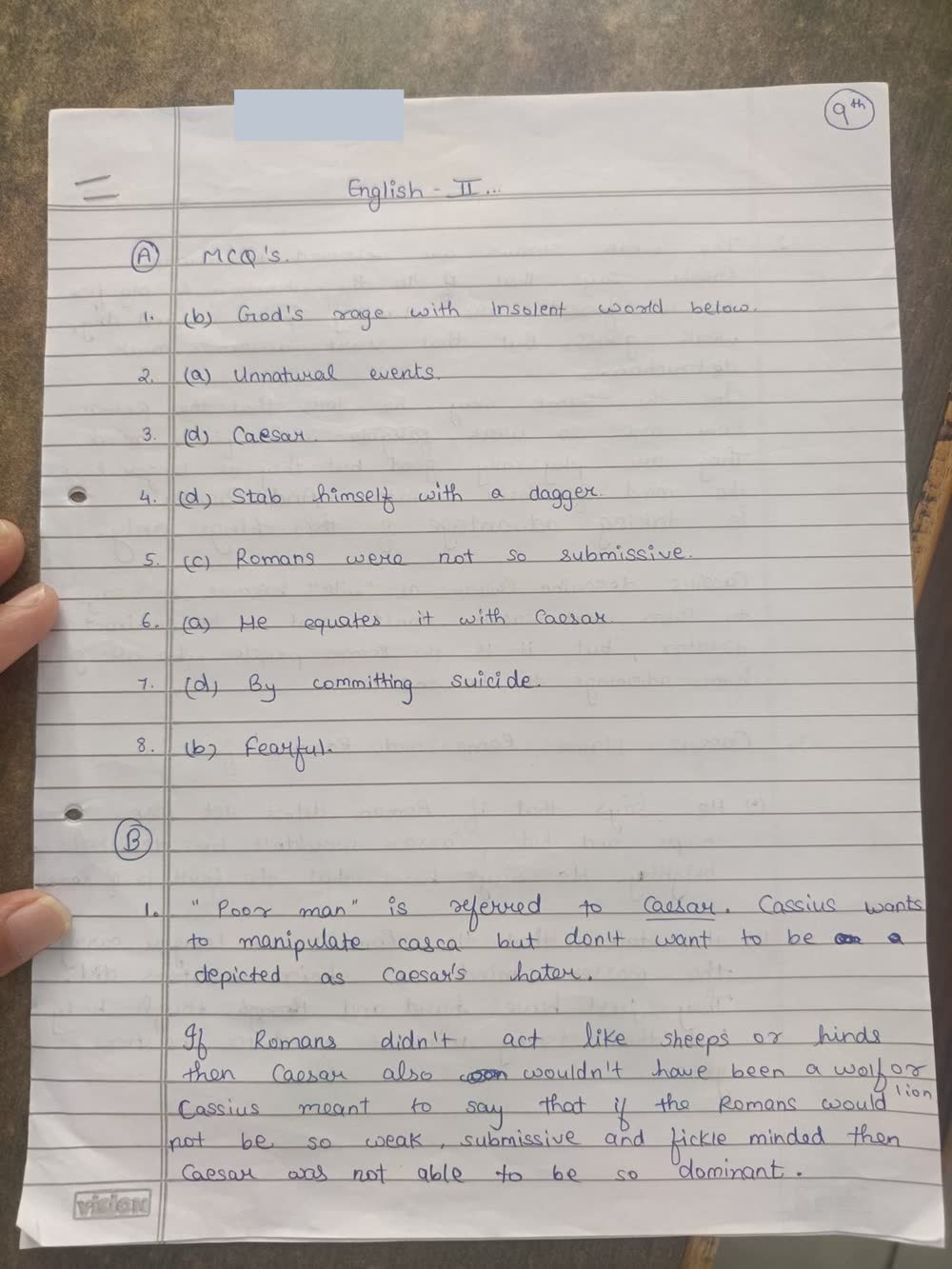
Section A — the eight multiple-choice answers, then Section B begins
How does Casca interpret the nature’s fury of a storm showering fire?
Correct - option (B).
What is meant by ‘prodigies’ in this scene?
Correct - option (A).
Who, according to Cassius, is a source of as much fear as the strange outbreaks of nature?
Correct - option (D).
What would Cassius do if Caesar would be crowned as the king?
Correct - option (D).
According to Cassius, Caesar would not have become a ruthless dictator if ________
Correct - option (C).
How does Cassius interpret the storm in this scene?
Correct - option (A).
How would Cassius deliver Cassius from bondage?
Correct - option (D).
In what condition is Casca in a state of servitude, according to Cassius?
Correct - option (B).
Who is referred to as a “poor man”? On what condition he would not have been a wolf or a lion?
You correctly identified Caesar as the “poor man.” You also explained that Caesar’s power and dominance arise from the Romans’ weakness and submissiveness, including the sheep and hinds comparisons. The answer could be made clearer by explaining separately that sheep symbolise weakness and submission, while hinds symbolise timidity and helplessness.
Page 2 of 6
2 questions on this page · 6 of 6 marks
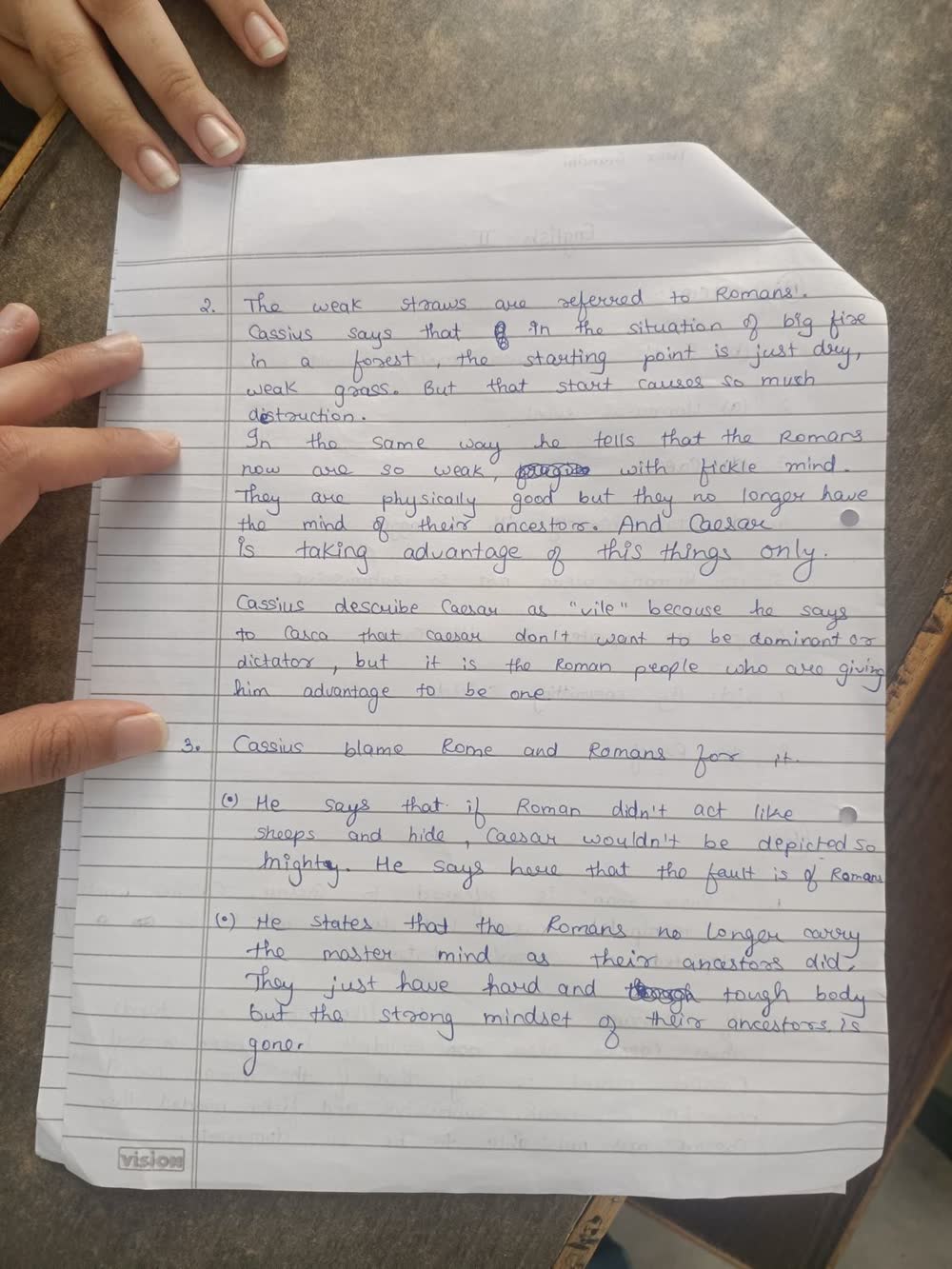
Explain how the sentence “Those that…weak straws” refers to Caesar. In what way is Caesar “vile” in the eyes of Cassius?
You correctly explain that the weak straws represent the weak and submissive Romans whose behaviour allows Caesar to rise to great power. You also correctly explain that Cassius considers Caesar unworthy and that the Roman people give him the opportunity to become dominant. Your answer could be made clearer by directly stating that Cassius regards Caesar as an inferior man.
Does Cassius blame Caesar or Rome? Give three reasons given by him for the greatness of Caesar at this time.
You correctly identify that Cassius blames Rome and the Romans rather than Caesar. You also give two valid reasons: the Romans are weak and submissive, and they have neglected the strength and wisdom of their ancestors. This fully answers the question.
Page 3 of 6
2 questions on this page · 7 of 7 marks
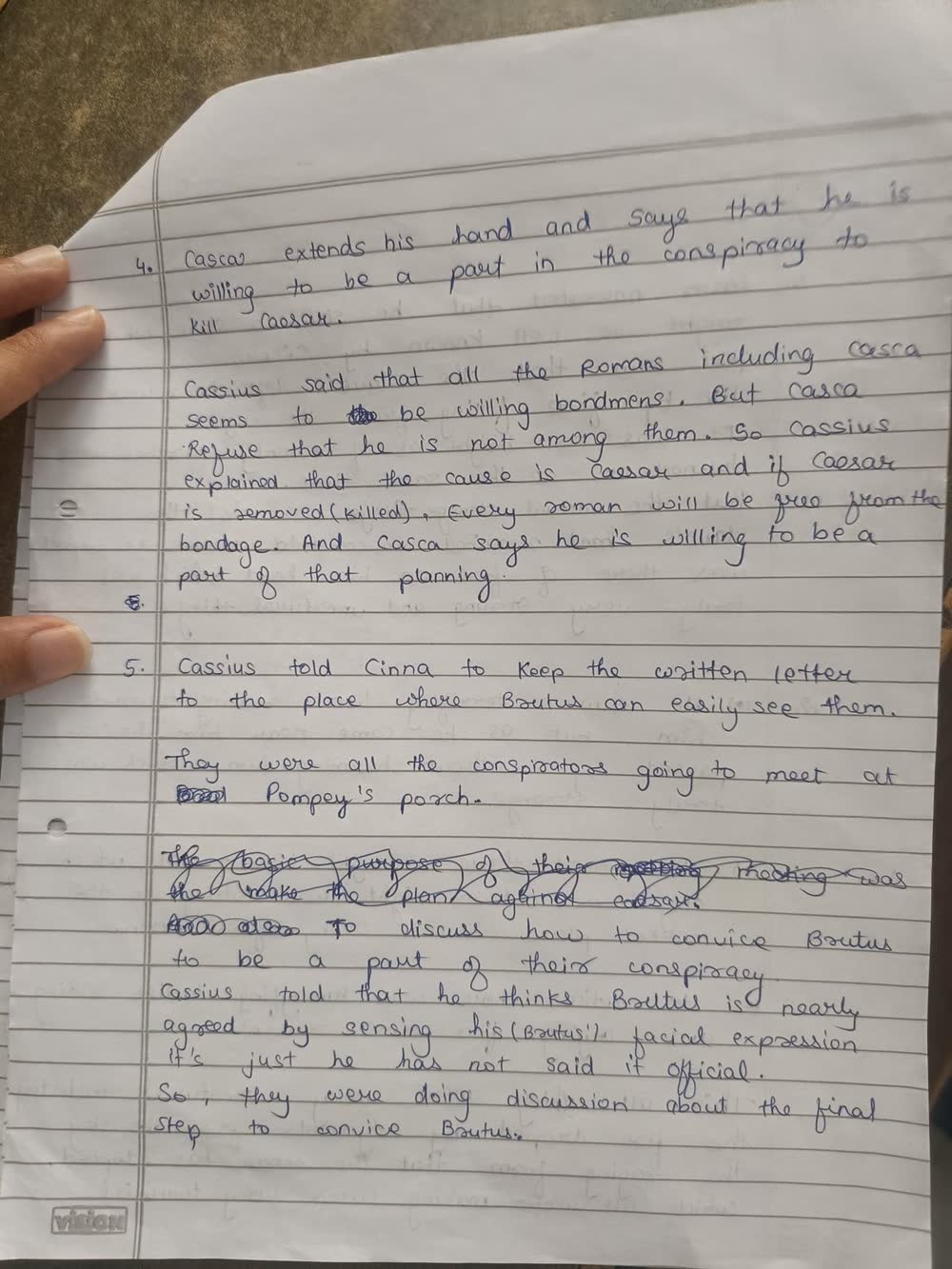
What does Casca extend to Cassius as a sign of fellowship? What does he say he is willing to do?
You correctly identify Casca’s gesture of extending his hand and explain that he is willing to join the conspiracy against Caesar. You also clearly mention his readiness to take part in the planning or undertaking. The additional explanation is not necessary, but it does not affect the correctness of your answer.
What appointment must Cassius and Casca keep later that night? Where will these friends meet? What will be the purpose of their meeting?
Marked again after your answer was found on page 3 — the grader had missed it. A complete answer: you name Pompey's Porch as the meeting place, say that all the conspirators were to gather there, and give the purpose — to plan against Caesar and settle the final step to win Brutus over. Full marks.
Page 4 of 6
2 questions on this page · 5 of 6 marks
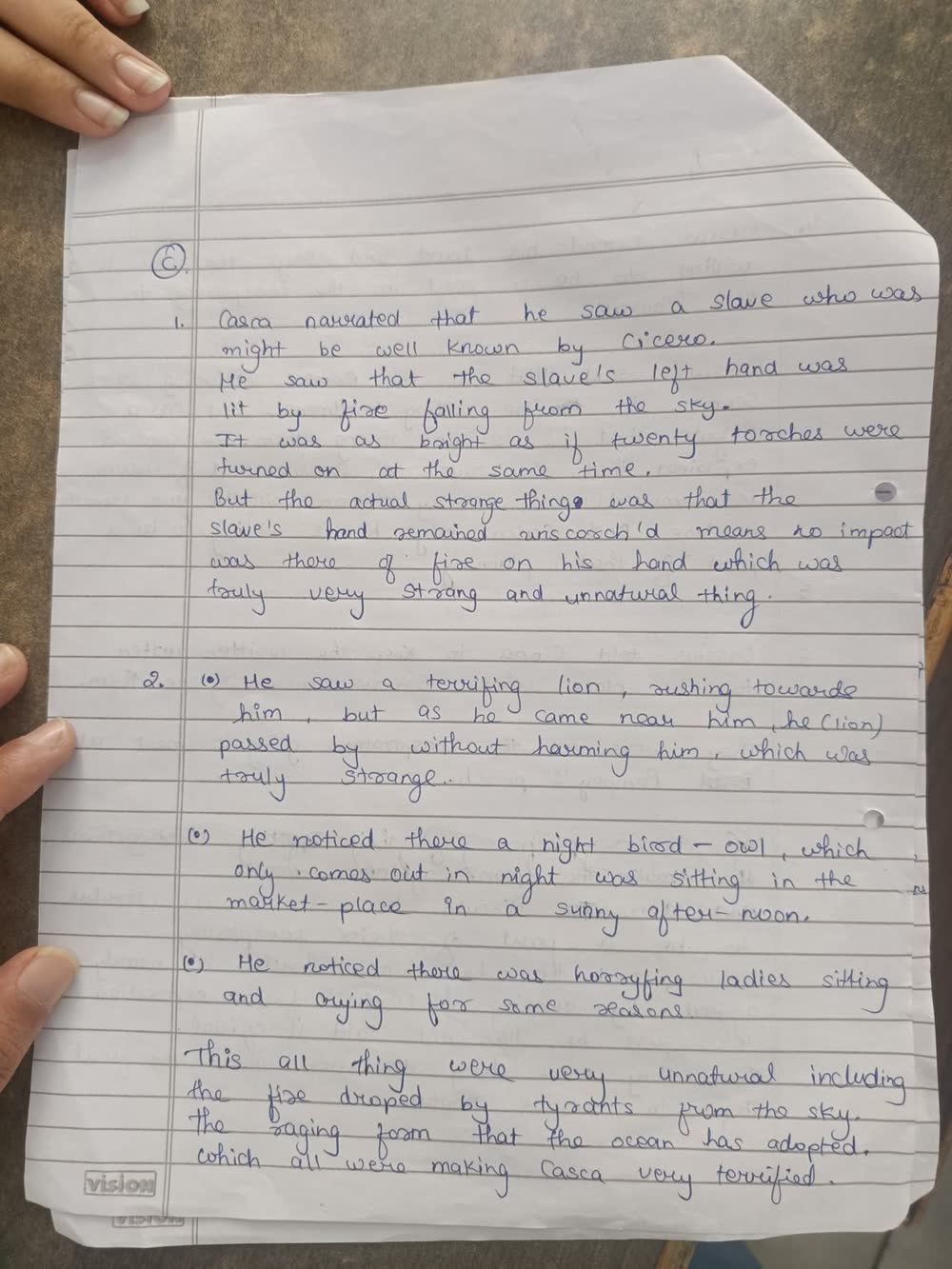
This page was photographed sideways. It has been turned upright here; the grader read it as it came.
Narrate in your own words the “wonderful” sight seen by Casca as given in the extract.
You correctly identified the slave and his raised left hand. You also clearly conveyed that the hand appeared to blaze like twenty torches and yet remained unscorched. The extra explanation about the strange sight is not necessary, but it does not affect the correctness of your answer.
Apart from the sight in (i) above, describe three unnatural sights that Casca narrates after this extract.
You correctly described the lion passing by without harming Casca and the owl sitting in the marketplace during the daytime. You missed the sight of men on fire walking through the streets unharmed. The statement about ladies sitting and crying is not one of Casca’s narrated unnatural sights.
Page 5 of 6
2 questions on this page · 6 of 6 marks
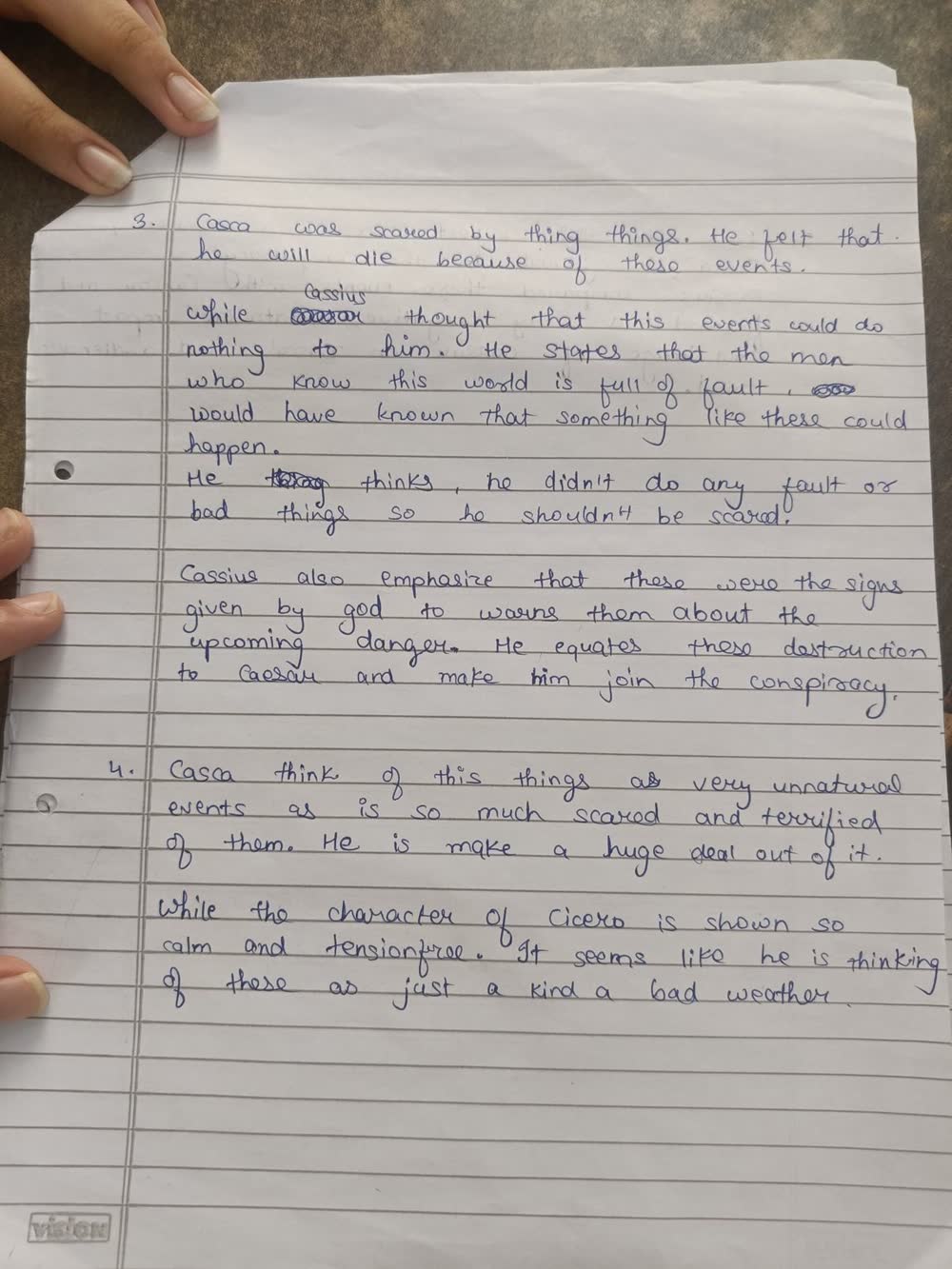
What does Casca believe about the unnatural events? How is his belief used by Cassius to make him join the conspirators?
You correctly identify Casca’s fear of the unnatural events and recognise them as signs from God. You also explain that Cassius uses these signs as a warning connected with Caesar and persuades Casca to join the conspiracy. The answer could be expressed more clearly and accurately, but all three required ideas are present.
In what way is Casca’s belief a contrast to the one expressed by Cicero about these events?
You correctly contrast Casca’s fearful interpretation of the unnatural events with Cicero’s calmer response. You also show that Casca treats the events as significant and alarming, while Cicero does not attach the same ominous meaning to them. Avoid calling Cicero’s view “just a kind of bad weather,” as this is a slightly imprecise expression, though the intended contrast is clear.
Page 6 of 6
1 question on this page · 0 of 4 marks
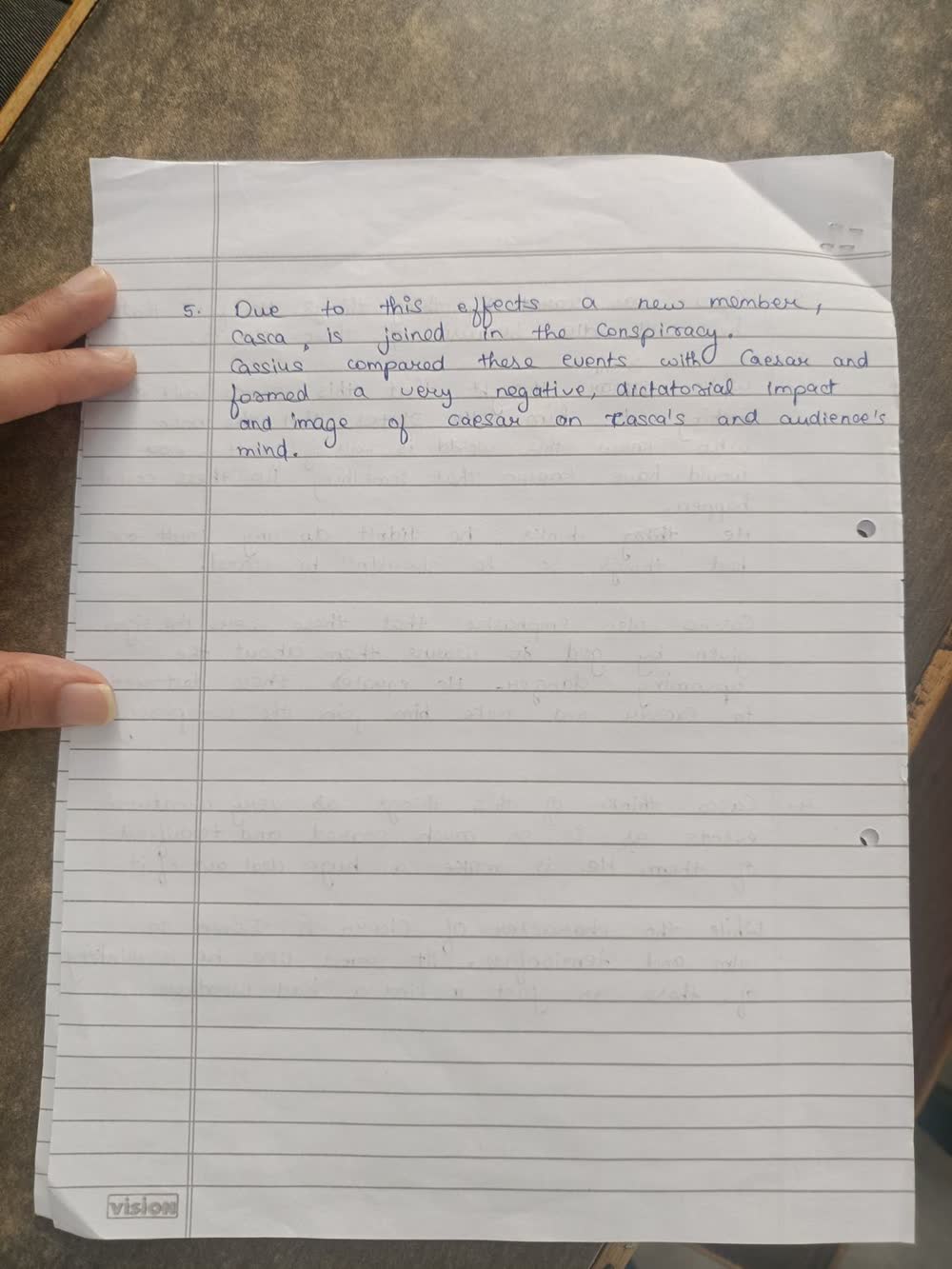
Also photographed sideways.
What impact do these strange things have on Caesar, as well as on the audience?
You identify that the events affect Caesar and the audience, but the effects are not explained accurately. You needed to show that the supernatural signs unsettle Caesar by warning of danger, and that they create wonder, fear and suspense in the audience. You also needed to link them to the foreshadowing of Caesar’s assassination.
The two to look at twice
Q13, where it got it wrong first. Read that feedback again: “Marked again after your answer was found on page 3 — the grader had missed it.” The first pass did not find the answer, because the student had written it on a different page from the one the question sat on. It was found, marked 4 of 4, and the line saying so was left in the student’s feedback rather than quietly deleted. That is the failure mode worth knowing about before you buy: not bad handwriting, but an answer written somewhere the grader was not looking. It is also the reason the teacher approves before anything is released.
Q18, the zero. One question out of eighteen scored nothing, and the comment says precisely what was missing — that the signs unsettle Caesar, that they create suspense in the audience, and that they foreshadow the assassination. A teacher reading that can agree or overrule it in a second, which is the point. A vendor showing you only the three-out-of-three answers is hiding the only part of the output you would actually have argued with.
This is also why we publish no accuracy percentage. On your papers, in your subject, in your students’ handwriting, the only number worth anything is the one you generate yourself.
Common questions
Is this a demo, or a real student’s paper?
It is a real paper, sat in a real test at a real centre, and the marks are the ones the system produced on the first pass. The only changes are the ones described above: the student’s handwritten name is covered and the centre is not named, because the paper belongs to them and the student is a minor. Nothing in the marking or the feedback has been rewritten, reordered or cleaned up.
Did a teacher write the feedback afterwards?
No. Every line under every question is what the checking produced, printed as it came. A teacher’s job in the real flow is to read it and approve it — no mark reaches a student until they do, and there is no setting that turns that off. What a teacher does not have to do any more is write eighteen comments per student by hand.
What happens to a page photographed sideways?
Two of these six pages were. They are turned upright before anything is read, which is why they look straight here. That is worth knowing because it is the single most common reason a centre’s first upload comes back with answers marked as missing — not the handwriting, the rotation.
Will it read handwriting worse than this?
Some, certainly. This sheet is ordinary Class 9 handwriting on ruled paper in blue ink, which is the common case, but it is one sample and your students are not this student. That is the whole reason the first paper is checked free: send one you have already marked yourself, put our marks next to yours, and you will know in about fifteen minutes.
Now send one of yours.
A paper you have already checked, so you can compare mark for mark. Takes about fifteen minutes and the first one is free.
We reply the same day. How the checking works · What it costs